Setting Screen Time Boundaries: Practical Frameworks for Families Who Want Balance, Not Bans
Gaming doesn't have to be all-or-nothing. Here's how Christian families are finding balance — without making screens the enemy.
Setting Screen Time Boundaries: Practical Frameworks for Families Who Want Balance, Not Bans
Subtitle: Gaming doesn't have to be all-or-nothing. Here's how Christian families are finding balance — without making screens the enemy.
The Fight You Didn't Sign Up For
It happens in nearly every Christian home with kids. The timer dings. The screen goes dark. And World War III breaks out in your living room.
"Five more minutes!"
"But I'm in the middle of a match!"
"Everyone else gets to play longer!"
You didn't become a parent to spend your evenings negotiating with a small human who treats a Nintendo Switch like oxygen. But here you are, dreading the daily screen-time battle, wondering if every other family has this figured out except yours.
They don't. Barna research found that nearly three in four parents are concerned about technology's impact on their children — including AI, screens, and digital media. That's not three in four parents who have a perfect system. That's three in four parents who are worried, which means most of us are figuring this out as we go, one meltdown at a time.
Here's the good news: you don't need a perfect system. You need a sustainable one. And the research has shifted dramatically in the last few years toward approaches that actually work for real families — approaches that look a lot more like wisdom and a lot less like martial law.
This guide isn't about eliminating screens. It's about putting them in their proper place so your family can thrive. Here are the frameworks that are actually working.
What the Research Actually Says (It's Not What You Think)
If your screen-time philosophy was shaped by articles from ten years ago, you might be working from outdated information. The American Academy of Pediatrics used to recommend strict time limits — famously, no more than two hours of recreational screen time per day for older kids. They removed those specific limits back in 2016. The current guidance, updated through 2026, focuses on something very different: quality over quantity, context over clock-watching.
The AAP now emphasizes family time, mindful use, and whether screen activities are replacing sleep, exercise, or face-to-face relationships. Their recommended starting point? One small step: device-free meals. That's it. Build from there.
The Brain Science: Dopamine, Reward, and Real Life
Let's talk about what screens actually do to developing brains — because the answer is more nuanced than "screens rot your brain."
A landmark NIH study of nearly 2,000 children (the Adolescent Brain Cognitive Development Study, or ABCD) found that kids who played video games three or more hours per day actually performed better on cognitive tests involving impulse control and working memory than kids who never played. Their brains showed higher activity in regions associated with attention and memory. That's real data from real kids.
But — and this is important — the same group also scored higher on measures of attention problems, depression symptoms, and ADHD. The researchers noted these scores did not reach clinical significance, meaning neither group was actually at risk for diagnosable problems. The takeaway? Gaming isn't destroying children's minds. But it's not harmless either. The dose makes the poison.
Other research tells a more cautionary story about excessive use. Neuroimaging studies have found that heavy gaming (defined in some studies as roughly ten hours per day) can reduce gray matter in the prefrontal cortex — the part of the brain responsible for judgment, impulse control, and decision-making. That region doesn't fully mature until age 25 to 30, which means adolescents are already working with hardware that struggles to self-regulate. Add a dopamine-heavy activity designed by professionals to maximize engagement, and you've got a genuine challenge.
Research published in Nature found that gaming can flood the pleasure center of the brain with dopamine at levels comparable to stimulant drugs. The brain compensates by producing less dopamine naturally. The result? Real life starts to feel flat by comparison.
This isn't moral panic. It's neurochemistry. And it means that the goal isn't to eliminate gaming — it's to keep it from becoming the most interesting thing in a child's life.
Sleep: The Underrated Factor
If you only change one thing after reading this guide, make it this: no screens for one to two hours before bedtime.
The research on blue light and sleep is unequivocal. Blue light (the wavelength emitted by phones, tablets, and TVs) suppresses melatonin — the hormone that tells your brain it's time to sleep. A 2024 study in the journal Chronobiology in Medicine found that just two hours of evening light exposure caused an average 1.1-hour circadian phase delay. Translation: your kid's brain thinks bedtime is an hour later than it actually is.
The effects cascade. Sleep deprivation impairs attention, emotional regulation, and academic performance. It also increases irritability — which means the morning after a late-night gaming session, you're not just dealing with a tired kid. You're dealing with a kid whose prefrontal cortex is running on fumes.
This isn't about being the fun police. It's about protecting the thing that makes every other good thing possible: rest.
Why "Just Ban It" Doesn't Work
Some Christian parents default to the nuclear option: no video games, no smartphones, no screens except schoolwork. And if that works for your family, genuinely, more power to you. But for most families, blanket bans create problems of their own.
Psychology research has consistently shown that restriction can backfire. In a classic study, researchers told five- and six-year-olds they were forbidden from eating red M&Ms while other colors were freely available. Later, when given unrestricted access, the forbidden-fruit children consumed significantly more red M&Ms than children who were never restricted. The ban didn't create self-control. It created obsession.
The same pattern shows up with screen time. Children whose parents heavily restrict junk food show stronger emotional responses to junk food advertisements. The restriction itself amplifies the allure.
This doesn't mean you should hand your kid an iPad and wish them luck. It means that the goal of boundaries is to build self-regulation, not to enforce dependence on external control. A thirteen-year-old who has never made a tech decision will become an eighteen-year-old who has no idea how to manage their first smartphone in a college dorm. The training wheels have to come off eventually — and they should come off gradually, while you're still there to catch them.
The Collaborative Approach
Dr. Alok Kanojia, a Harvard Medical School psychiatrist who specializes in gaming and mental health, recommends a collaborative approach to rule-setting. When he asks children as young as six or seven what they think a reasonable screen-time limit should be, most suggest one to two hours per day — often surprising parents who expected a fight.
The key is asking the right questions:
"What do you think is too much time on screens?"
"If you were the parent and your kid was failing classes because of gaming, what would you do?"
"Have you ever noticed that you feel worse after binge-watching or binge-gaming?"
When kids help set the boundaries, they internalize the reasoning. They're not obeying an arbitrary rule imposed from above. They're following a standard they helped create.
This aligns beautifully with biblical wisdom. Proverbs 22:6 says, "Train up a child in the way he should go, and when he is old he will not depart from it." Training isn't controlling. It's equipping.
Framework 1: The Gaming Window
The Gaming Window is the simplest framework in this guide — and the one most families should start with.
Here's how it works: instead of letting gaming happen whenever there's free time, you designate a specific window for it. Outside that window, screens are available for other purposes (homework, creative projects, video calls with family), but gaming specifically happens only during the agreed-upon time.
Example Windows:
The After-School Window: Gaming allowed from 4:00 PM to 5:30 PM on school days. Homework must be done first. When the window closes, the console sleeps until tomorrow.
The Post-Dinner Window: Gaming allowed from 7:00 PM to 8:00 PM. No exceptions after 8:00 — that's wind-down time for reading, family, or sleep prep.
The Rotating Window: Each child gets a 90-minute gaming block on weekdays, scheduled around their other commitments. No overlap means no fighting over the TV.
The Gaming Window works because it removes the constant negotiation. The rule isn't "maybe, if you've been good, if there's time." The rule is "here's when it happens, period." Kids push back less against clear boundaries than against vague ones.
The Christian angle: The Gaming Window is an exercise in self-control — one of the fruits of the Spirit (Galatians 5:22-23). It's not about denying pleasure; it's about ordering pleasure so it doesn't disorder everything else.
Framework 2: The Weekend Rule
Some families find that weekday gaming is simply too disruptive — homework, sports, church activities, and early bedtimes make it hard to fit in without everything feeling rushed. For these families, the Weekend Rule can be a game-changer.
The Weekend Rule means no gaming Monday through Friday. Gaming is allowed on Saturdays and Sundays, with agreed-upon time limits.
Why it works:
It eliminates the daily negotiation entirely during the school week.
It makes gaming feel like a treat rather than a default activity.
It protects homework time, sleep schedules, and extracurriculars.
It creates anticipation rather than entitlement.
The tradeoffs:
Some kids struggle with the buildup of anticipation and may binge on weekends.
Social gaming with friends (who may play on weeknights) becomes harder.
It can feel punitive if not framed positively.
How to make it work:
Frame it as a privilege, not a punishment. "We don't game on school nights because your brain needs rest, your body needs sleep, and your relationships need attention. Saturday morning gaming is something you earn by handling your responsibilities all week."
Also: allow flexibility for special circumstances. A snow day, a long weekend, or a new game release can be exceptions without destroying the framework. Rigid rules break. Flexible principles bend.
Framework 3: The Digital Sabbath
Of all the frameworks in this guide, the Digital Sabbath is the most explicitly Christian — and arguably the most transformative.
The concept is simple: one day a week, the whole family rests from screens. Not just gaming. All screens. No phones, no TV, no tablets, no computers (except genuine emergencies). For twenty-four hours, the family lives like it's 1995.
The biblical foundation is obvious. The Sabbath was God's idea, not ours. Exodus 20:8 commands us to "remember the Sabbath day, to keep it holy." Deuteronomy 5:14 extends the rest to everyone in the household — including children, servants, and even animals. Rest is built into the created order.
But most modern families have never experienced a day without screens. The thought is almost panic-inducing. Which is exactly why it's so powerful.
What a Digital Sabbath does:
It breaks the dopamine cycle. One day of reduced stimulation allows the brain's reward system to recalibrate.
It forces creativity. Bored kids eventually find something to do — usually something physical, social, or creative.
It reorients the family toward each other. Without screens as the default activity, conversation, games, and shared experiences fill the space.
It models trust in God's provision. We rest because we believe the world will keep turning without our constant input.
Practical tips for starting:
Pick the day that works for your family. Sunday is natural for many Christian families, but Saturday or Friday evening to Saturday evening may work better depending on your schedule.
Prepare in advance. Have board games, art supplies, outdoor gear, and a list of screen-free activities ready.
Do it together. A parent scrolling Instagram while the kids go screen-free is hypocrisy, not leadership.
Start small if needed. Try a Digital Sabbath afternoon before attempting a full day.
Expect resistance for the first three weeks. After that, most families who stick with it report that the Sabbath becomes something they look forward to rather than endure.
One family we spoke with described their Sunday Digital Sabbath as "the best day of the week." The first month was rough. The second month was manageable. By month three, their kids started planning screen-free activities in advance. The Sabbath became a gift, not a restriction.
Framework 4: Screen-Free Zones
Some boundaries are about when screens happen. Others are about where.
The Dinner Table
If you do nothing else, make mealtimes screen-free. The research on family dinners is overwhelming. Regular family meals are a protective factor for adolescent mental health, reducing the likelihood of obesity, drug use, and depression while improving academic performance.
A study in JAMA Pediatrics found that as screen time increased among toddlers, adult words, child vocalizations, and conversational turns all decreased. The mechanism is simple: responsive back-and-forth interaction between adults and children builds brain architecture, language, and social capacity. When screens are present at meals, that interaction drops dramatically.
The dinner table is where children learn to listen, to argue respectfully, to tell stories, and to be heard. It's where family culture is formed. Protect it fiercely.
Bedrooms
The second most important screen-free zone is the bedroom. Screens in bedrooms are associated with later bedtimes, poorer sleep quality, and higher rates of anxiety and depression in adolescents. The blue light is part of the problem, but so is the psychological availability — the sense that something interesting might be happening online, pulling attention away from rest.
Our recommendation: no TVs in bedrooms, no phones in bedrooms overnight, and no handheld gaming in bed. Charge all family devices in a central location (the kitchen counter works well) starting one hour before bedtime.
This isn't just for kids. Parents who keep phones by their bed sleep worse too. Make it a family standard.
Keeping Gaming Social (Not Isolating)
One of the most important distinctions in the screen time conversation is between social gaming and solitary gaming. They're not the same thing, and treating them as if they are misses something crucial.
A teenager playing Fortnite with friends on voice chat is having a social experience — imperfect, mediated by screens, but genuinely social. A teenager playing the same game alone in their room for six hours is having an isolating experience. Same game, different outcome.
The goal for Christian families shouldn't be to eliminate gaming. It should be to shape gaming toward connection rather than isolation.
Family Game Nights
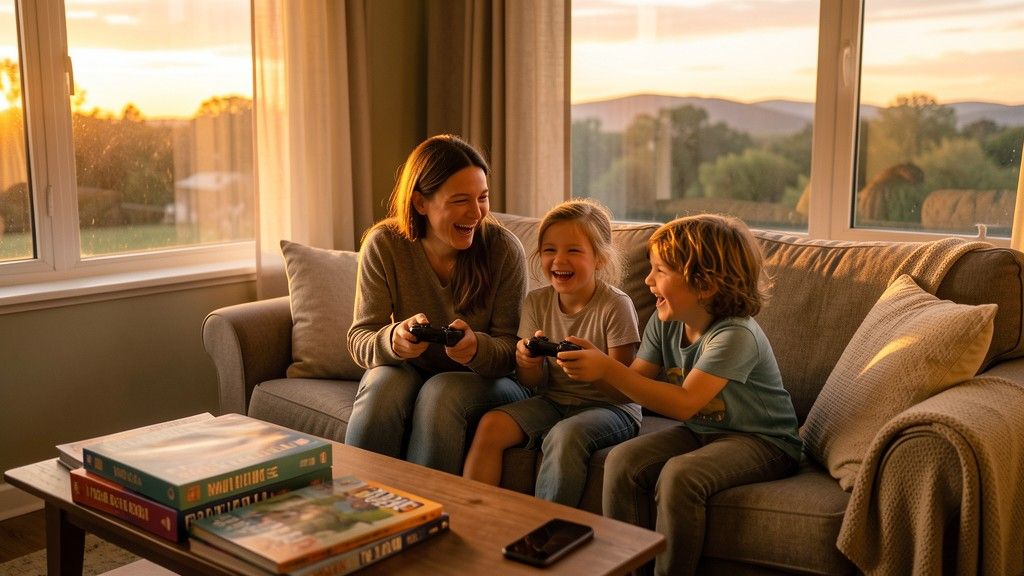
The simplest way to keep gaming social is to play together. Family game nights aren't just wholesome Instagram content — they're formative experiences where children learn sportsmanship, cooperation, and how to lose gracefully.
Console co-op games that work for mixed ages:
It Takes Two — Requires genuine cooperation. One of the best relationship-building games ever made.
Overcooked! All You Can Eat — Chaotic, hilarious, and genuinely requires teamwork.
LEGO games (Star Wars, Harry Potter, Marvel) — Drop-in/drop-out co-op, low stakes, endless content.
Mario Kart 8 Deluxe — Accessible to almost any age, competitive but lighthearted.
Minecraft (creative or survival mode together) — Collaborative building, shared world, endless possibilities.
Super Mario Bros. Wonder — Classic platforming, genuinely funny, playable at multiple skill levels.
The key is playing with your kids, not just letting them play near you. Ask questions about their games. Let them teach you the controls. Be the student sometimes.
Local Multiplayer vs. Online
Local multiplayer (everyone on the same couch) has advantages that online gaming can't replicate: physical proximity, shared laughter, and the ability to hand someone a controller when it's their turn. Prioritize local multiplayer when possible.
That said, online gaming with real friends isn't the enemy. The danger is when online friends replace in-person relationships. A healthy mix of both is the goal.
Conversation Scripts That Don't Start Fights
The words you use matter. Here are some scripts, drawn from family therapists and experienced parents, that frame boundaries as care rather than control.
Setting a new limit
> "I love you, and I want you to enjoy gaming. I also want you to get enough sleep, do well in school, and have energy for the other things you love. Let's figure out a schedule that lets you do all of those things."
Addressing pushback
> "I know this feels unfair. When I was your age, I didn't like limits either. But my job isn't to be your friend — it's to help you grow into someone who can make good decisions on their own. We're going to try this for two weeks and then check in. If it's genuinely not working, we'll adjust."
Admitting your own struggle
> "Can I be honest with you? I struggle with my phone too. Sometimes I check it when I should be paying attention to you, and that's not right. I'm working on it. We're all figuring this out together."
Ending a gaming session
> "I know you want to finish the match. I also know that when you play past the timer, it gets harder to stop the next time. The rule is the rule — not because I'm mean, but because I care about your brain more than your character."
When they compare to other families
> "Every family is different. Some families have different rules because they have different struggles. Our rules are based on what you need, not what someone else needs. I know that's frustrating. It's also loving."
Parent Modeling: The Part Nobody Wants to Hear
Here's the uncomfortable truth: your screen habits shape your children's screen habits more than any rule you write on a whiteboard.
Research has found that children whose parents were heavy smartphone users showed significantly more behavioral problems related to screen time — even when the parents imposed strict limits on the children. Kids don't do what you say. They do what you do.
This isn't a guilt trip. It's an invitation. If you want your children to have a healthy relationship with technology, work on your own relationship first.
Practical steps for parents:
Put your phone in a drawer during dinner. Not face-down. In a drawer.
Don't check your phone first thing in the morning. Model a different starting ritual.
Admit when you've been distracted by your phone and apologize. Your kids need to see that adults struggle too — and that struggle can be acknowledged and addressed.
Join the Digital Sabbath. If the whole family rests from screens, you're not the enforcer. You're a fellow participant.
The Christian framework for this is clear: self-control is a fruit of the Spirit, and it's meant to grow in all of us — not just our children. Galatians 5:22-23 doesn't have an age cutoff.
Your 30-Day Starter Plan
You don't have to implement everything at once. Here's a gradual, sane path forward:
Week 1: Implement one screen-free zone. Start with dinner. No phones, no tablets, no TV during meals.
Week 2: Establish a Gaming Window. Pick a time block that works for your family and stick to it. Use a timer. When it dings, gaming stops.
Week 3: Move all device charging to a central location. No phones in bedrooms overnight — including parents.
Week 4: Try your first Digital Sabbath. Start with a half-day if a full day feels impossible.
Ongoing: Have a monthly family meeting to review what's working and what isn't. Adjust as needed. The goal isn't perfection — it's progress.
Final Thoughts
Screens aren't going away. Your children will live their entire lives in a world where technology is woven into everything they do. The question isn't whether they'll use screens. It's whether they'll use screens wisely.
Christian parents have something unique to offer here. We don't have to rely on secular self-help frameworks alone. We have the fruit of the Spirit — love, joy, peace, patience, kindness, goodness, faithfulness, gentleness, and self-control — as the standard against which we measure every habit, including our digital ones.
We also have the Sabbath. In a world that never stops scrolling, the radical act of rest — one day, no screens, just presence — is a witness to something better. It's a declaration that we are not slaves to our devices. We are children of a God who commands us to rest because He knows what we need.
Your kids won't remember every rule you enforced. They will remember whether you were present. Whether you played with them. Whether you apologized when you got it wrong. Whether you showed them, day after day, that there are good things in this world more interesting than whatever's on a screen.
Set the boundaries. Hold them with love. And then join your kids in the beautiful, messy, offline world that God made for them — and for you.
About Crosspad Gaming's Family Guides
This guide is part of Crosspad Gaming's Essential Family Guides series — deep dives into the questions every Christian parent asks about games and play. For guidance on evaluating specific games, read our Content Compass guide. For help choosing age-appropriate tabletop RPGs, read The Complete Guide to Christian-Friendly Tabletop RPGs.
Continue exploring Family coverage from Crosspad Gaming.