The Complete Guide to Christian-Friendly Tabletop RPGs
Dungeons & Dragons isn't demonic. But it's not automatically harmless either. Here's how to evaluate any RPG with confidence — and 15 games worth bringing to your table.
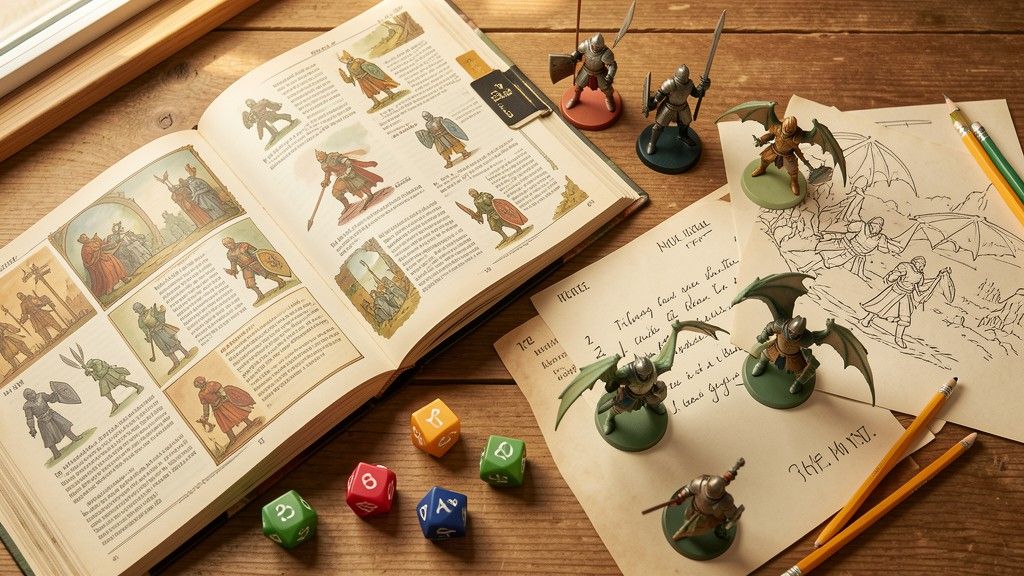
The Complete Guide to Christian-Friendly Tabletop RPGs
Subtitle: Dungeons & Dragons isn't demonic. But it's not automatically harmless either. Here's how to evaluate any RPG with confidence — and 15 games worth bringing to your table.
The Conversation Every Christian Parent Eventually Has
It usually starts with a question at the dinner table: "Mom, can I play Dungeons & Dragons?"
Maybe a friend at youth group mentioned it. Maybe your kid saw Stranger Things and noticed the kids rolling funny-shaped dice. Maybe you played it yourself back in the 80s and remember the Satanic Panic headlines.
Your gut reaction might be suspicion. Your second reaction might be guilt for being suspicious. After all, doesn't the church have a history of overreacting to harmless fun? Rock music, Harry Potter, Pokémon — each one was supposed to destroy a generation, and each one turned out to be... mostly fine.
But "mostly fine" isn't the same as "automatically good." And "the church overreacted before" isn't a reason to stop thinking now.
This guide exists because you deserve better than two bad options: moral panic on one side, and dismissive hand-waving on the other. Tabletop RPGs are worth understanding. Some are genuinely excellent tools for family bonding, creativity, and even spiritual growth. Others have content that thoughtful Christian parents will want to avoid or adapt. The difference isn't hard to spot once you know what to look for.
Here's everything you actually need to know.
What Is a Tabletop RPG, Really?
A tabletop role-playing game (TTRPG) is collaborative storytelling with rules. One person — usually called the Game Master (GM), Dungeon Master (DM), or Guide — describes a world, characters, and situations. The other players each control a single character and decide what that character does. Dice add unpredictability. The rules add structure so that "I attack the dragon" isn't just an imagination contest — it's a resolved action with stakes.
That's it. No board required. No screen. Just dice, paper, and people talking.
The most famous TTRPG is Dungeons & Dragons (D&D), created in 1974 by Gary Gygax and Dave Arneson. Today, D&D is experiencing a cultural renaissance. It's in TV shows, podcasts, and major motion pictures. An estimated 50 million people worldwide have played it. But D&D is only one system among hundreds. And that's where this gets interesting for Christian families — because the medium is neutral, but the content varies wildly.
The Three Real Concerns
When Christian parents ask about RPGs, their concerns usually cluster around three things: magic, violence, and worldview. Let's address each honestly.
1. Magic
This is the concern that comes up most. D&D has wizards, spells, and spellbooks. For some parents, that's an automatic no-go.
But here's what most guides won't tell you: D&D "magic" is not occult practice disguised as a game. It's a mechanical resource-management system with fantasy flavoring. A wizard character doesn't perform rituals, draw sigils, or invoke spiritual forces. They spend "spell slots" — a limited daily resource, like mana in a video game — to produce predetermined effects described in a rulebook. The player says, "I cast Light," rolls a die, and a torch appears. That's the entire interaction.
In the lore of D&D's most popular setting (the Forgotten Realms), magic is treated as a natural force — like gravity or electricity — that certain people can manipulate. It's impersonal and mechanistic, not relational or spiritual. That has its own theological problems (it replaces a personal Creator with a neutral cosmic force), but it's a worldview problem, not an occult problem. Your kid isn't learning witchcraft. They're learning a game's economy.
Compare this to the magic in C.S. Lewis's Chronicles of Narnia or J.R.R. Tolkien's Lord of the Rings. Both use magic. Both were written by devout Christians. In those stories, magic represents deeper spiritual realities — but no one accuses Lewis of promoting the occult, because the context and intent are clear.
Context matters. In D&D, magic is typically used by player characters to heal wounds, protect the innocent, and defeat evil forces. The game assumes a moral framework where helping people is good and hurting them is bad. That's not nothing.
Some TTRPGs do contain occultic material worth avoiding. Systems like Kult or parts of Vampire: The Masquerade treat demons, ritual magic, and blasphemy as central themes. Those aren't neutral flavoring — they're the point of the game. Distinguishing between "fantasy magic as game mechanic" and "occult magic as immersive theme" is exactly the kind of discernment this guide is designed to help you develop.
2. Violence
Most TTRPGs involve combat. Characters fight monsters, bandits, or evil cultists using swords, spells, and arrows. The level of detail varies enormously.
In D&D 5th Edition, combat is abstract. You roll to hit, roll damage, and the enemy loses hit points. There's no gore system, no wound descriptions, and death is usually clean. Compare this to video games where enemies explode in fountains of blood, and D&D's tabletop violence is remarkably tame.
However, some systems go darker. Warhammer Fantasy Roleplay is famously grim. Call of Cthulhu includes sanity mechanics where characters slowly lose their minds. Mörk Borg is explicitly nihilistic. These systems aren't just "violent" — they're bleak. The worldview underneath them is often despair, random cruelty, or cosmic indifference. That distinction matters for Christian families.
3. Worldview
This is the concern that's hardest to spot but most important to evaluate.
Every TTRPG operates on assumptions about reality. Is there good and evil, or is everything gray? Are the gods real and personal, or are they distant cosmic forces? Is the universe ordered and meaningful, or random and cruel? Is death the end, or is there an afterlife?
Original D&D was built on a surprisingly Christian cosmology. Gary Gygax, one of the game's creators, was a professing Christian. He designed the game so that the forces of good were mechanically stronger than the forces of evil. Angels and demons existed in a hierarchy. Holy symbols worked against undead. The paladin class was explicitly a holy warrior who drew power from virtue.
Modern D&D (5th Edition, published by Wizards of the Coast) has softened some of these edges. The pantheon is more generic. Alignment is less central. But the core assumption remains: cooperation is better than selfishness, helping people is good, and the party wins by working together.
Some indie RPGs flip this entirely. Mörk Borg assumes the world is ending and nothing matters. Vampire: The Masquerade assumes morality is a social construct used by the powerful to control the weak. These aren't just "dark themes" — they're competing theological claims. A Christian parent evaluating RPGs should pay at least as much attention to the worldview underneath the mechanics as to the mechanics themselves.
A 5-Question Framework for Evaluating Any RPG
You don't need to be a theologian or a game designer to make good decisions. You just need to ask the right questions. Here's a practical framework you can use for any RPG your kids ask about:
Question 1: What is the source of power in this game?
If characters use "magic," is it treated as a neutral game mechanic (like D&D's spell slots), or as a spiritual practice the characters perform? Are there ritual descriptions, sigils, or invocations that mirror real-world occultism? The closer the in-fiction magic gets to actual occult practice, the more caution is warranted.
Question 2: What does the game assume about good and evil?
Is there a real moral framework, or is everything relative? Do the heroes help people and defeat villains, or does the game reward betrayal, cruelty, or exploitation? A game where players backstab each other for personal gain is teaching something different than a game where the party cooperates to save a village.
Question 3: How is violence handled?
Is combat abstract and optional, or graphic and central? Can players solve problems through negotiation, creativity, and kindness? The best family-friendly RPGs make violence one option among many — and often the least interesting one.
Question 4: What does this game do to my child's heart?
This is the Philippians 4:8 test: "Whatever is true, whatever is noble, whatever is right, whatever is pure, whatever is lovely, whatever is admirable — if anything is excellent or praiseworthy — think about such things." Does this game cultivate virtues like courage, loyalty, creativity, and compassion? Or does it cultivate vices like greed, callousness, or contempt?
Question 5: Is this the right game for my child's maturity level?
A 16-year-old can engage thoughtfully with complex moral questions that would overwhelm a 9-year-old. Some games are designed for adults and contain themes — romance, horror, political intrigue, existential dread — that simply aren't appropriate for children. Age ratings on RPGs are rough guidelines at best. You know your child better than any box does.
Christian RPGs Built for Faith
If you want an RPG where the Christian worldview isn't just tolerable but central, several options exist. Here are the best-known and most readily available.
Lightraiders (formerly DragonRaid)
Created in 1984 by Christian counselor Dick Wulf during the height of the Satanic Panic, DragonRaid was explicitly designed as a Christian alternative to D&D. It uses Scripture memory and application as core mechanics — players literally quote Bible verses to overcome challenges in the fantasy world of EdenAgain.
The game was revived in 2018 by James R. Hannibal as Lightraiders Academy, with updated art and mechanics while keeping the discipleship focus. It's available through BackerKit and Lightraiders.com. Best for ages 10+ with parental involvement.
Content Compass: Edifying. Scripture is central. Combat exists but is less important than spiritual growth.
Holy Lands RPG
Holy Lands is a Christian historical-fantasy RPG set in the Dark Ages (500–1000 AD). Players take roles like knights, saints, scholars, and pilgrims in a world where Christianity is objectively true. Characters don't cast spells — they call on Miracles, divine acts granted through faith. Sorcery, by contrast, is explicitly demonic and corrupting.
The system has been actively developed for over 25 years. It's mechanically deeper than Lightraiders and appeals to older teens and adults who want tactical combat alongside spiritual themes. Available at holylandsrpg.com.
Content Compass: Edifying. Explicitly Christian. Violence is present but framed as righteous defense against evil.
Deliverance
Deliverance is a cooperative board game and RPG hybrid focused on spiritual warfare between angels and demons. It's not a traditional TTRPG — it uses tactical miniatures and scenario-based campaigns — but it delivers an explicitly Christian narrative experience. With a BoardGameGeek rating of 8.7/10, it's one of the highest-rated Christian games ever made.
Best for families who want structured, mission-based play with Bible-based lore. Available at playdeliverance.com.
Content Compass: Edifying. Spiritual warfare theme may be intense for very young children.
Testament (d20 System)
Published by Green Ronin, Testament is a D&D 3rd Edition supplement for roleplaying in Biblical times — specifically the Old Testament era. It requires the D&D Player's Handbook but replaces the standard fantasy pantheon with Yahweh, Baal, Marduk, and other historical Near Eastern deities as understood through Scripture.
This is a niche product, but it's invaluable for families who want to use the familiar D&D mechanics while exploring Biblical history. Best for teens and adults with some D&D experience.
Content Compass: Positive to Edifying. Biblical setting. Some violence consistent with Old Testament narratives.
Wolves of God
Created by Kevin Crawford (known for the excellent Stars Without Number), Wolves of God is a historical fantasy RPG set in 710 AD England. It's not marketed as a "Christian game," but the setting assumes a world where Christianity is the dominant faith, monasteries are centers of learning, and saints walk the land.
Crawford describes it as "a fantasy game where you play Christians." The magic system is low and grounded — more miracles and folk wisdom than fireballs. It's beautifully written and mechanically elegant. Best for teens and adults.
Content Compass: Positive. Historical Christianity is assumed true in the setting. Some grim elements appropriate to the Dark Ages setting.
15 Family-Friendly RPGs, Organized by Age
Not every family wants an explicitly Christian RPG. Many just want something wholesome, creative, and age-appropriate. Here are 15 excellent options, organized by the age they work best for.
Ages 4–7: First Adventures
Amazing Tales — The simplest RPG on this list. Rules fit on one page. Players describe what their character does, and the parent/guide decides if it works. No math required. The game explicitly encourages making magic feel "magical" (wonder-filled, not mechanical) and keeping fights child-friendly. Created by a parent for his 4-year-old daughter.
No Thank You, Evil! — Designed by Monte Cook Games using a simplified version of their Cypher System. Players complete sentences like "I'm a [Noun] who [Verbs]" to create characters. Uses cards, big dice, and colorful components. Includes a guide specifically for helping kids run their own games.
Ages 6–10: Heroic Kids
Hero Kids — The most popular RPG for young children. Combat-focused but simple, with pre-made characters and short adventures designed to finish in under an hour. Uses d6 dice pools. No reading required for the core mechanics. A fantastic bridge between pretend play and structured games.
Ryuutama — A Japanese "heartwarming" RPG about ordinary people going on journeys. No epic destiny, no world-ending threat — just travelers helping each other through beautiful landscapes. The GM (called a Ryuujin, or "Dragon-Person") is explicitly a supportive, nurturing figure. Gentle, pastoral, and deeply wholesome.
Ages 10–14: Growing Into Complexity
Dungeons & Dragons 5th Edition — D&D 5e is more family-friendly than most people realize. The core rules contain no graphic violence, no sexual content, and no occult ritual descriptions. The Starter Set adventures (Dragon of Icespire Peak, Dragons of Stormwreck Isle) are specifically designed for new players. With a thoughtful DM who skips the darker monster descriptions, D&D 5e works well for this age group.
The One Ring — A RPG set in Tolkien's Middle-earth, published by Free League. If your family loves The Lord of the Rings, this is the natural next step. The mechanics emphasize hope, fellowship, and the struggle against shadow. Tolkien's Christian worldview is baked into the setting's DNA.
Ironsworn — A free, award-winning RPG about sworn quests in a dark fantasy world. What's remarkable is how it handles failure: setbacks become opportunities for character growth. The game encourages keeping vows, helping communities, and finding hope in hardship. No GM required — it works brilliantly as a cooperative family game.
Ages 14+: Teen and Adult Tables
Burning Wheel — A fantasy RPG where what your character believes mechanically drives the story. Players write down their character's beliefs (e.g., "The Doctrine holds the answer to every question in life" or "I will protect the innocent, no matter the cost"), and the GM creates challenges that test those beliefs. It's demanding but extraordinarily rich for players who want to explore faith, virtue, and moral struggle through fiction.
The Chronicles of Darkness (Mortal rules only) — The base "mortal humans" rules for this system are excellent for running modern-day mystery and investigation games with no supernatural elements whatsoever. Think Scooby-Doo, not Vampire. The system is clean and the horror is entirely optional.
Quest — A beautifully designed fantasy RPG that replaces complex rules with simple, elegant mechanics. Combat is de-emphasized in favor of creativity, problem-solving, and roleplay. The core book is explicitly inclusive and encourages tables to establish boundaries together — a built-in Session Zero mentality.
Bluebeard's Bride — Skip this one. It's an explicitly mature horror game about abuse and coercion. Included here as a reminder that not all indie RPGs are family-friendly, and the "artistic" label doesn't automatically mean wholesome.
Bonus: Digital Tools for Family Play
Roll20 and Foundry VTT let families play together online when schedules don't align for in-person sessions. D&D Beyond simplifies character creation enormously. These tools aren't games themselves, but they remove logistical barriers that stop many families from starting.
The Session Zero Conversation Template
The single most important thing you can do for your family's TTRPG experience happens before anyone rolls dice. It's called Session Zero — a pre-game conversation where the group establishes expectations, boundaries, and goals.
Professional game masters use tools like Lines & Veils and the X-Card to keep tables safe. These aren't buzzwords — they're practical boundary tools that align with Christian wisdom about guarding hearts and protecting the vulnerable.
Here's a Session Zero template designed specifically for Christian families:
1. What kind of story do we want to tell?
"Do we want to be heroes who help people? Adventurers exploring lost ruins? Pirates on the high seas?" Establish the tone together. If anyone's uncomfortable with a direction, change it. The GM isn't a dictator — they're a facilitator.
2. What are our Lines?
Lines are hard boundaries — topics that never appear in our game. Common family lines include:
No sexual content or romance
No graphic descriptions of violence or torture
No occult rituals, demon worship, or blasphemy as player behavior
No player-versus-player betrayal
No swearing at the table
Write them down. Everyone agrees.
3. What are our Veils?
Veils are topics that can happen in the story but happen "off-screen" — mentioned, not described. Examples might include:
A character dies (we know it happened, but we don't describe the body)
A monster is scary (we know it's scary, but we don't describe gore)
A villain does something evil (we know they did it, but we don't act it out)
4. How do we use the X-Card?
Place a card (literally any card) in the center of the table. Anyone can tap it at any time, no explanation needed, and the current scene changes immediately. "The goblin ambush becomes a peaceful negotiation." "The haunted house becomes a deserted cottage." No questions asked, no shame given.
This isn't weakness — it's wisdom. Proverbs 4:23 says, "Above all else, guard your heart." The X-Card is a tool for guarding hearts in real time.
5. What are we doing about faith at the table?
This is the uniquely Christian addition. Will you pray before sessions? Will you discuss how the game's events relate to real virtue and vice? Will you explicitly Christianize the setting, or play it straight and discuss afterwards?
There's no single right answer. Some families play D&D as-is and use it as a springboard for conversations about courage, sacrifice, and justice. Others prefer explicitly Christian games where Scripture is part of the mechanics. Both approaches are valid. The key is being intentional, not accidental.
What the Research Says: TTRPGs and Child Development
If you're still unsure whether tabletop RPGs are "worth it" for your family, consider the evidence.
A growing body of research shows that TTRPGs support social-emotional learning (SEL) in children. A 2023 study published in the journal Games for Health found that structured roleplay improved children's self-efficacy, communication skills, and ability to work in teams. The key mechanism is low-stakes failure: kids can try social strategies, fail, learn, and try again — all within the safety of fiction, where the consequences don't follow them to school on Monday.
TTRPGs also build:
Creativity and problem-solving: There's no single right answer. Players must think laterally.
Empathy: Stepping into another person's shoes — even a fictional elf's shoes — exercises perspective-taking.
Math and reading: D&D involves addition, subtraction, probability, and substantial reading comprehension.
Public speaking: Players regularly describe their actions to a group, building confidence in self-expression.
Delayed gratification: Character advancement happens over months, not minutes. That's rare in modern entertainment.
Adam McDivitt, a professional game master and licensed mental health therapist, uses D&D specifically as a therapeutic tool for children with ADHD and autism. The structured social interactions provide a "safety net" that unstructured playground games often lack.
None of this means RPGs are necessary for child development. Board games, sports, and imaginative free play offer many of the same benefits. But it does mean that the medium itself isn't the enemy. Like any tool, it can be used well or poorly.
Navigating the Hard Conversations
Sooner or later, your kid will encounter a friend whose parents think D&D is demonic. Or they'll find an old tract online claiming that RPGs lead to suicide and occult involvement. Or they'll read about the 1980s Satanic Panic and wonder if you're hiding something from them.
Here's how to handle it:
Be honest about history. The church really did overreact in the 1980s. Some of the anti-D&D claims were outright fabricated. Patricia Pulling, the founder of Bothered About Dungeons and Dragons (BADD), blamed her son's suicide on D&D — but investigations revealed he had a history of depression and had barely played the game. When Christians spread false information, we damage our credibility. Admitting this builds trust.
Be honest about real concerns too. D&D can be played in unhealthy ways. Obsessive play, escapism, and dark content are real risks — just like they're risks with video games, novels, and any other immersive hobby. The issue isn't the game; it's the player's relationship with the game.
Distinguish between "I don't want you playing this" and "this is objectively evil." You might decide D&D isn't right for your family based on maturity, sensitivity to magic themes, or simply having better alternatives. That's a perfectly valid parenting decision. You don't need to prove the game is demonic to justify saying no.
Offer alternatives enthusiastically. "We're not doing D&D, but we're going to try Ryuutama — it's a game about traveling through beautiful landscapes and helping people. You can be a merchant cat who sells magic tea." A positive alternative removes the sting of a restriction.
Getting Started: Your First Family RPG Night
Ready to try it? Here's the simplest possible path:
Pick a game. For families with kids under 10, start with Hero Kids or Amazing Tales. For older kids, try D&D 5e Starter Set or The One Ring.
Schedule 2 hours. Most RPG sessions run 2–3 hours, but your first one should be shorter. Leave them wanting more.
Run a Session Zero. Use the template above. It takes 15 minutes and prevents 90% of problems.
Keep it simple. Don't worry about every rule. If a rule gets in the way of fun, ignore it. The goal is collaborative storytelling, not rules mastery.
Debrief afterwards. "What did your character learn? What would you have done differently? Did anything make you uncomfortable?" This five-minute conversation turns entertainment into formation.
Pray. Thank God for imagination, creativity, and time together. Ask for wisdom to use these gifts well.
Final Thoughts
Tabletop RPGs aren't for every family, and not every RPG is for every family. But the medium itself — collaborative storytelling, dice, imagination, and fellowship around a table — is profoundly compatible with Christian values. It practices cooperation over competition. It exercises creativity as a gift from the Creator. It builds the kind of face-to-face community that screens systematically destroy.
Dungeons & Dragons isn't demonic. But it's not automatically harmless either. The difference lies in the hands holding the dice — and the hearts guiding the story.
May your tables be full, your stories be true, and your fellowship be rich.
About Crosspad Gaming's Family Guides
This guide is part of Crosspad Gaming's Essential Family Guides series — deep dives into the questions every Christian parent asks about games and play. For age-specific game recommendations, explore our Content Compass ratings. For practical boundaries around screen time, read our Screen Time Boundaries guide.
Continue exploring Family coverage from Crosspad Gaming.